
A Unicorn in Monoceros: the 3M⊙ dark companion to the bright, nearby red giant V723 Mon is a non-interacting, mass-gap black hole candidate
by Silva Järvinen on 2021-02-05
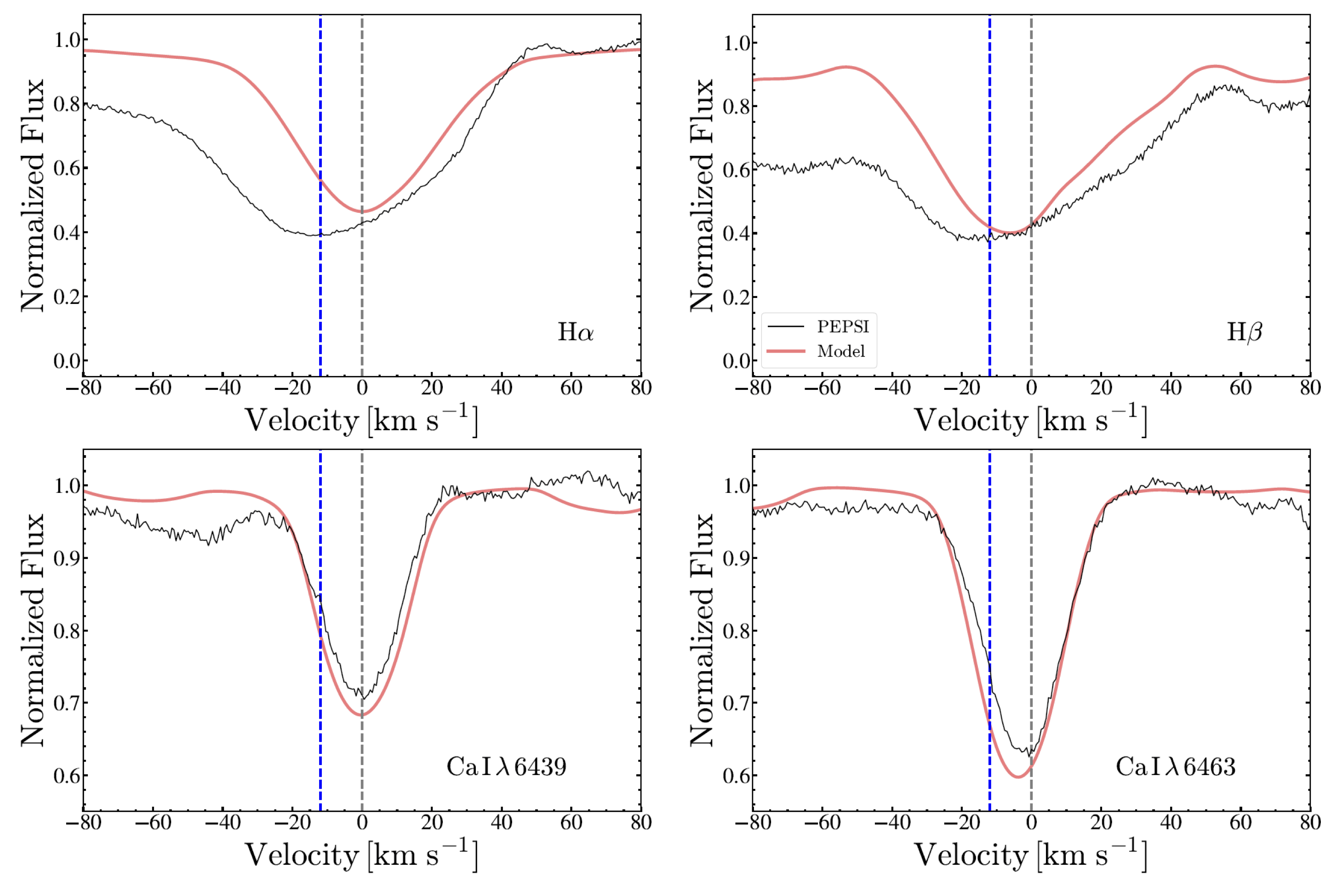
We report the discovery of the closest known black hole candidate as a binary companion to V723 Mon. V723 Mon is a nearby (d\=460 pc), bright evolved red giant in a high mass function nearly circular binary (𝑃 = 59.9 d, e approx. 0). Analyses of the stellar spectra and spectral energy distribution (SED) give 𝑇eff = 4440 K, 𝐿 = 173 𝐿s⊙ and 𝑅 = 22 𝑅⊙. Matching these parameters to MIST evolutionary models indicates a mass of the visible giant of 𝑀giant = 1.07 +/- 0.24 𝑀⊙. V723 Mon is a known variable star, previously classified as an eclipsing binary, but its All-Sky Automated Survey (ASAS), Kilodegree Extremely Little Telescope (KELT), and Transiting Exoplanet Survey Satellite (TESS) light curves are those of a nearly edge-on ellipsoidal variable. Detailed models of the light curves constrained by the period, radial velocities and stellar temperature give an inclination of 𝑖 = 87 deg, a mass ratio of 0.30 +/- 0.02, and a companion mass of 𝑀comp = 2.91 +/- 0.08 𝑀⊙, a stellar radius of the giant of 𝑅giant = 23.6 +/-1.0 𝑅⊙, and a giant mass of 𝑀giant = 0.87 +/-0.08 𝑀⊙ , consistent with our other estimates. We identify a likely non-stellar, diffuse veiling component with contributions in the 𝐵 and 𝑉-band of ~64% and ~23%, respectively, and a luminosity of ~20 𝐿⊙. The SED and the absence of continuum eclipses imply that the companion mass must be dominated by a compact object even if the companion is a binary. We do observe eclipses of the Balmer lines when the dark companion passes behind the giant, but their velocity spreads are low compared to observed accretion disks. The X-ray luminosity of the system is 𝐿X = 1 x 10^30 erg/s, corresponding to 𝐿/𝐿edd ~10^-9. The simplest explanation for the massive companion is a single compact object, most likely a black hole in the “mass gap”, although a double neutron star binary is possible.
Read more: Jayasinghe et al. 2021, MNRAS, 504, 2577